API Rate Limiter Engine
Low-Level Design for a high-performance, thread-safe API rate limiter in Java supporting multiple algorithms.
API Rate Limiter — Low-Level Design
1. Problem Statement
Modern web applications, APIs, and microservice architectures are vulnerable to a wide variety of traffic anomalies:
- Denial-of-Service (DoS) & Brute Force Attacks: Malicious actors bombarding login or checkout endpoints with automated scripts.
- Resource Starvation: Aggressive web scrapers or poorly configured internal microservices monopolizing shared CPU, database connections, or downstream third-party quotas.
- Cascading Service Failures: Uncontrolled traffic spikes causing downstream database connection pools to exhaust, triggering cascading outages across dependent services.
Building a production-grade API Rate Limiter requires solving four core low-level engineering challenges:
- Ultra-Low Latency Overhead (< 1ms): Rate limiting sits directly on the critical request path. Every millisecond spent calculating limits directly adds latency to user requests.
- Deterministic & Fair Enforcement: Rate limits must strictly adhere to configured quotas without dropping valid bursts or leaking extra quota across window boundaries.
- Thread Safety & High Concurrency: Under tens of thousands of concurrent requests, counter updates must be atomic without causing global lock contention.
- Clean, Extensible Object-Oriented Architecture: The engine must support multiple rate-limiting algorithms (Token Bucket, Leaky Bucket, Sliding Window Log) and allow interchangeable storage engines without rewriting business logic.
This document outlines the evolutionary engineering design—beginning with the in-memory MVP foundation (Token Bucket), detailing its class relationships and mathematical subtleties, and establishing a roadmap for scaling into policy rules and distributed clusters.
2. Product Requirements
2.1 Core MVP Requirements
- PR-1 (Request Interception & Decision): When a request reaches the API gateway or controller, the rate limiter decides synchronously whether to allow the request through or reject it with an HTTP
429 Too Many Requests. - PR-2 (Multi-Algorithm Support): The design must support multiple rate-limiting strategies:
- Token Bucket: Accommodates bursty traffic while enforcing an average sustained rate.
- Leaky Bucket: Enforces smooth, constant-rate processing.
- Sliding Window Log: Provides strictly accurate temporal limits without window-boundary anomalies.
- PR-3 (Client Identification): Requests are isolated by a unique
clientId(such as an API Key, User ID, or IP address). A rate-limited client must never degrade or block traffic for other clients.
2.2 Extended Requirements (Future Scaling)
- PR-4 (Tier-Based Rate Limiting): The system should be able to enforce differentiated quotas based on user subscription tiers (e.g., Free vs. Pro vs. Enterprise tiers with distinct capacity and refill rates).
- PR-5 (Endpoint-Specific Rate Limiting): The rate limiter should be able to enforce custom rate limits per API endpoint or route (e.g., strict quotas for resource-heavy or sensitive paths like
POST /api/v1/auth/login, contrasted with higher allowances for read-heavy routes likeGET /api/v1/products).
3. Functional Requirements
FR-1: Core Contract
public interface ApiRateLimiter {
    boolean allowRequest(Policy policy, RequestContext requestContext);
}- Contract Simplicity: Returns a primitive
boolean(trueif allowed,falseif rejected). - Context & Policy Driven: Decouples caller identity (
RequestContext) and dynamic rate quotas (Policy) from algorithm execution. - Zero Allocation on Hot Path: Avoids wrapping results in wrapper objects or
Optionalto eliminate JVM garbage collection overhead on high-throughput paths.
FR-2: Algorithm Parameters (Token Bucket & Policy)
- Burst Capacity (): The maximum number of tokens a bucket can hold at any instant. This defines the maximum allowable burst.
- Limit (): The number of tokens replenished within a defined time frame.
- Time Window (): The duration (in seconds) over which the limit is earned. Together, defines the sustained throughput limit.
FR-3: Scope Boundaries (MVP)
- In-Memory Operation: The initial MVP operates in-memory within a single JVM process.
- Cold Start Guarantee: A newly observed client starts with a full bucket (
tokens = capacity), allowing legitimate initial bursts without false rejections. - Client Isolation: Each client possesses their own isolated bucket state.
4. Step 1: The Baseline Foundation (MVP Design)
The MVP focuses on an elegant, extensible object-oriented structure implementing the Token Bucket algorithm, while preparing extension points for Leaky Bucket and Sliding Window Log.
4.1 The Core MVP Entities
[ Client / Application ]
           │
           ▼
[ ApiRateLimiterService ] ──(has-a)──► [ ApiRateLimiter ]
                                              ▲
                                              │ (creates)
                                  [ ApiRateLimiterFactory ]
                                              │
                    ┌─────────────────────────┼─────────────────────────┐
                    │ (implements)            │ (implements)            │ (implements)
                    ▼                         ▼                         ▼
      [ TokenBucketRateLimiter ]   [ LeakyBucketRateLimiter ]  [ SlidingWindowLogRateLimiter ]
                    │
                    ▼ (composition)
[ TokenBucket ]ApiRateLimiterService(Gateway Facade): The single entry point for applications. Holds references to anApiRateLimiterand aPolicyResolver, coordinating request admission checks.ApiRateLimiter(Strategy Interface): The core contract definingallowRequest(Policy policy, RequestContext requestContext). Adheres to the Open/Closed Principle, enabling transparent strategy switching.ApiRateLimiterFactory(Creational Factory): Encapsulates the instantiation of concrete rate limiters (createTokenBucketLimiter(),createSlidingWindowLogLimiter(),createLeakyBucketLimiter()), shielding callers from constructor complexity.TokenBucketRateLimiter(Algorithm Coordinator): Manages a thread-safe registry of client buckets (Map<String, TokenBucket>), lazily instantiating buckets based on incoming policies.TokenBucket(Client State Engine): Represents an individual client’s bucket. Holds current tokens and timestamps, and evaluates lazy replenishment math atomically upon each request.LeakyBucketRateLimiter&SlidingWindowLogRateLimiter: Concrete implementation placeholders ready for upcoming milestones.
4.2 Class Diagram
classDiagram
    direction TB

    class ApiRateLimiterService {
        - apiRateLimiter: ApiRateLimiter
        - policyResolver: PolicyResolver
        + ApiRateLimiterService(apiRateLimiter: ApiRateLimiter, policyResolver: PolicyResolver)
        + allowRequest(requestContext: RequestContext): Boolean
    }

    class ApiRateLimiter {
        <<interface>>
        + allowRequest(policy: Policy, requestContext: RequestContext): Boolean
    }

    class ApiRateLimiterFactory {
        + createTokenBucketLimiter(): ApiRateLimiter
        + createSlidingWindowLogLimiter(): ApiRateLimiter
        + createLeakyBucketLimiter(): ApiRateLimiter
    }

    class TokenBucketRateLimiter {
        - map: Map~String, TokenBucket~
        + allowRequest(policy: Policy, requestContext: RequestContext): Boolean
    }

    class LeakyBucketRateLimiter {
        + allowRequest(policy: Policy, requestContext: RequestContext): Boolean
    }

    class SlidingWindowLogRateLimiter {
        + allowRequest(policy: Policy, requestContext: RequestContext): Boolean
    }

    class TokenBucket {
        - capacity: long
        - limit: long
        - timeWindowSeconds: long
        - tokens: long
        - lastRefillTimestamp: long
        + tryConsume(tokensRequested: int): boolean
        - refill(): void
    }

    ApiRateLimiterService --> ApiRateLimiter : has-a
    ApiRateLimiterFactory ..> ApiRateLimiter : «creates»
    TokenBucketRateLimiter ..|> ApiRateLimiter : implements
    LeakyBucketRateLimiter ..|> ApiRateLimiter : implements
    SlidingWindowLogRateLimiter ..|> ApiRateLimiter : implements
    TokenBucketRateLimiter *-- TokenBucket : composition
Design Decision: Why skip
AbstractApiRateLimiterfor the MVP?
While an abstract class could theoretically sit between the interface and implementations, different rate-limiting algorithms have vastly distinct internal states (Token Bucket uses counters and timestamps, Leaky Bucket uses queues or leak intervals, Sliding Window Log uses sorted timestamp collections). In accordance with YAGNI (You Aren’t Gonna Need It), we avoid premature inheritance until clear common logic emerges across multiple algorithms.
4.3 The Core Algorithm: “Lazy Refill” Token Bucket
A common anti-pattern in naive rate limiters is running a background daemon timer (e.g. ScheduledExecutorService) that ticks every second to add tokens to all client buckets:
- The Background Timer Flaw: If a service has 500,000 unique client buckets in memory, the background worker must iterate through 500,000 objects every second—burning CPU cycles and causing lock contention, even for clients that have been idle for days.
The Lazy Refill Solution
Instead of proactively pushing tokens, we calculate replenished tokens on-demand when a client request arrives:
4.4 The Integer Remainder Retention Trick 🧮
When calculating token replenishment using integer math, standard division drops remainders:
- Suppose
limit = 5pertimeWindowSeconds = 1(1 token every 200 ms). - If requests arrive every 100 ms:
tokensToAdd = (100 * 5) / 1000 = 0.- If
lastRefillTimestampis unconditionally updated to , those 100 ms are discarded forever. The client would never receive tokens despite waiting patiently!
Preserving Sub-Token Time
To achieve 100% precision using pure long integers without floating-point drift, we only advance lastRefillTimestamp by the time actually converted into whole tokens:
private void refill() {
    long now = System.currentTimeMillis();
    long elapsedMs = now - lastRefillTimestamp;

    if (elapsedMs <= 0) {
        return;
    }

    long timeWindowMs = timeWindowSeconds * 1000;

    // Calculate whole tokens earned in elapsed time
    long tokensToAdd = (elapsedMs * limit) / timeWindowMs;

    if (tokensToAdd > 0) {
        long newTokens = tokens + tokensToAdd;
        if (newTokens >= capacity) {
            tokens = capacity;
            lastRefillTimestamp = now; // Bucket full; discard overflow time
        } else {
            tokens = newTokens;
            long timeUsedMs = (tokensToAdd * timeWindowMs) / limit;
            lastRefillTimestamp += timeUsedMs; // Preserve unused fractional time!
        }
    }
}
Numerical Trace Example
- Configuration:
capacity = 10,limit = 5,timeWindowSeconds = 1(1 token per 200 ms).
| Time () | Event | Elapsed () | tokensToAdd | Action | Resulting tokens | lastRefillTimestamp |
|---|---|---|---|---|---|---|
| 0 ms | Bucket created & Req #1 arrives | 0 ms | 0 | Consume 1 token | 9 | 0 ms |
| 100 ms | Req #2 arrives | 100 ms | No tokens added; timestamp not moved | 8 (consumed) | 0 ms (preserved!) | |
| 200 ms | Req #3 arrives | 200 - 0 = 200 ms | 1 token added; timestamp moves by 200 ms | 8 () | 200 ms | |
| 100,000 ms | User returns after long idle | 99,800 ms | Tokens cap at 10; timestamp resets to | 9 (consumed) | 100,000 ms |
4.5 Concurrency & Thread-Safety Model
High-throughput systems require strict concurrency guarantees without coarse-grained bottlenecks:
- Bucket Registry (
ConcurrentHashMap):- Buckets are indexed by
clientId. - Newly seen clients instantiate their bucket via
computeIfAbsent():TokenBucket bucket = map.computeIfAbsent( requestContext.clientId(), k -> new TokenBucket( policy.burstCapacity(), policy.limit(), policy.timeWindowSeconds(), System.currentTimeMillis() ) );
- Buckets are indexed by
- Fine-Grained Bucket Locking (
synchronizedon Bucket):- Thread synchronization is isolated strictly to the individual
TokenBucketinstance:public synchronized boolean tryConsume(int tokensRequested) { ... } - Why this scales: 10,000 concurrent threads making requests for different clients execute in parallel without waiting on each other. Only concurrent requests for the same client serialize momentarily for a few CPU instructions.
- Thread synchronization is isolated strictly to the individual
5. Step 2: Policy & Request Context Layer (Tiers & Endpoint Routing)
To support PR-4 (Tier-Based Limits) and PR-5 (Endpoint-Specific Limits), we decouple policy resolution (business rules) from rate enforcement (algorithm execution).
5.1 Architecture & Class Connections
classDiagram
    direction TB

    class RequestContext {
        + clientId: String
        + tier: Tier
        + endpoint: String
    }

    class Tier {
        <<enum>>
        FREE
        PREMIUM
        ENTERPRISE
    }

    class Policy {
        <<record>>
        + limit: long
        + timeWindowSeconds: long
        + burstCapacity: long
    }

    class PolicyResolver {
        <<interface>>
        + getPolicy(requestContext: RequestContext): Policy
    }

    class DefaultPolicyResolver {
        - tierPolicies: Map~Tier, Policy~
        + getPolicy(requestContext: RequestContext): Policy
    }

    class ApiRateLimiterService {
        - apiRateLimiter: ApiRateLimiter
        - policyResolver: PolicyResolver
        + allowRequest(requestContext: RequestContext): Boolean
    }

    class ApiRateLimiter {
        <<interface>>
        + allowRequest(policy: Policy, requestContext: RequestContext): Boolean
    }

    class ApiRateLimiterFactory {
        + createTokenBucketLimiter(): ApiRateLimiter
        + createSlidingWindowLogLimiter(): ApiRateLimiter
        + createLeakyBucketLimiter(): ApiRateLimiter
    }

    RequestContext --> Tier : has-a
    DefaultPolicyResolver ..|> PolicyResolver : implements
    PolicyResolver ..> RequestContext : inspects
    PolicyResolver ..> Policy : resolves & returns
    ApiRateLimiterService --> PolicyResolver : has-a (resolves rule)
    ApiRateLimiterService --> ApiRateLimiter : has-a (enforces rule)
    ApiRateLimiterFactory ..> ApiRateLimiter : «creates»
    ApiRateLimiter ..> Policy : evaluates with
5.2 How the Components Connect
-
RequestContext→Tier(Association):- Encapsulates caller identity (
clientId), subscription plan (tier), and target path (endpoint). - Created at the gateway/filter level before rate limiting is evaluated.
- Encapsulates caller identity (
-
ApiRateLimiterService→PolicyResolver(Association):- The service holds a reference to a
PolicyResolver. - When
allowRequest(requestContext)is invoked, the service asks the resolver: “What is the quota for this user tier and endpoint?”
- The service holds a reference to a
-
PolicyResolver⇢Policy(Dependency):- Inspects
RequestContextand returns an immutablePolicycontaining(limit, timeWindowSeconds, burstCapacity). - Encapsulates precedence rules (e.g., endpoint-specific rules taking priority over global tier rules via
DefaultPolicyResolver).
- Inspects
-
ApiRateLimiterService→ApiRateLimiter(Association):- The service holds the algorithm engine (injected at startup).
- It delegates enforcement passing both the resolved policy and context:
Policy policy = policyResolver.getPolicy(requestContext);
return apiRateLimiter.allowRequest(policy, requestContext);
-
ApiRateLimiterFactory⇢ApiRateLimiter(Creational Dependency):- Encapsulates algorithm instantiation (
createTokenBucketLimiter()), shieldingApiRateLimiterServicefrom concrete constructor details.
- Encapsulates algorithm instantiation (
5.3 Request Execution Flow
sequenceDiagram
    autonumber
    actor Client as API Gateway / Controller
    participant Service as ApiRateLimiterService
    participant Resolver as PolicyResolver
    participant Limiter as ApiRateLimiter (e.g., TokenBucket)

    Client->>Service: allowRequest(RequestContext)
    Service->>Resolver: getPolicy(RequestContext)
    Resolver-->>Service: return Policy(limit, timeWindowSeconds, burstCapacity)
    Service->>Limiter: allowRequest(Policy, RequestContext)
    Limiter-->>Service: return true (Allowed) or false (429)
    Service-->>Client: return boolean decision
6. Step 3: Memory Hygiene & Eviction Layer (Background Sweeper)
In an in-memory rate limiter, every unique clientId (such as one-off mobile sessions or bot IP scans) instantiates an entry in the bucket registry (Map<String, TokenBucket>). Over months of uptime with millions of transient clients, an unbounded ConcurrentHashMap guarantees an eventual OutOfMemoryError: Java heap space.
To prevent memory leaks, we introduce a decoupled Background Sweeper that safely evicts idle buckets.
6.1 Safe Eviction Criteria & Race Condition Prevention
When is a bucket safe to evict?
A bucket is safe to delete if and only if:
- It has refilled to full
capacity(tokens == capacity).- It has remained idle past its TTL (
(now - lastRefillTimestamp) > ttlMillis).Why? If the client returns in the future, the rate limiter instantiates a brand-new bucket that starts full anyway. Deleting an idle, full bucket has zero side effects on quota enforcement.
Preventing the Eviction Race Condition
If the cleaner decides to remove a client while that exact client simultaneously sends a request:
- Synchronized Inspection:
TokenBucket.isStale(ttlMillis)is evaluated under the bucket’s monitor lock (synchronized). If a request is actively consuming a token, the cleaner waits. - Conditional Atomic Removal: The cleaner uses
map.remove(clientId, bucket), ensuring the entry is deleted only if the map’s current value is still that exact, unmodifiedbucketinstance.
6.2 Architecture & Class Connections
Following the Interface Segregation Principle (ISP) and the Command Pattern, we decouple the eviction contract (Cleanable) from both the rate-limiting contract (ApiRateLimiter) and the execution mechanism:
Cleanable(Interface): Implemented by any in-memory rate limiter that maintains ephemeral state. It declarescleanUpStaleEntries(long ttlMillis). Distributed limiters (e.g. Redis) do not implementCleanablebecause they rely on native key expiration (EXPIRE).RateLimiterCleaner(implements Runnable): A lightweight Command object whose sole responsibility is to triggercleanable.cleanUpStaleEntries(ttlMillis)when executed. It eliminates boilerplate thread lifecycles, executor pools, and manualstart()/close()management from the domain layer.- Execution Environment (Host Application / Schedulers): The cleaner is a plain
Runnable, allowing the host application total freedom to execute it via standardScheduledExecutorService, Spring@Scheduled, or Quartz jobs.
classDiagram
    direction TB

    class Runnable {
        <<interface>>
        + run(): void
    }

    class Cleanable {
        <<interface>>
        + cleanUpStaleEntries(ttlMillis: long): void
    }

    class RateLimiterCleaner {
        - cleanable: Cleanable
        - ttlMillis: long
        + RateLimiterCleaner(cleanable: Cleanable, ttlMillis: long)
        + run(): void
    }

    class ApiRateLimiter {
        <<interface>>
        + allowRequest(policy: Policy, requestContext: RequestContext): Boolean
    }

    class TokenBucketRateLimiter {
        - map: Map~String, TokenBucket~
        + allowRequest(policy: Policy, requestContext: RequestContext): Boolean
        + cleanUpStaleEntries(ttlMillis: long): void
    }

    class TokenBucket {
        - capacity: long
        - limit: long
        - timeWindowSeconds: long
        - tokens: long
        - lastRefillTimestamp: long
        + tryConsume(tokensRequested: int): boolean
        + isStale(ttlMillis: long): boolean
        - refill(): void
    }

    RateLimiterCleaner ..|> Runnable : implements
    RateLimiterCleaner --> Cleanable : has-a (delegates to)
    TokenBucketRateLimiter ..|> ApiRateLimiter : implements
    TokenBucketRateLimiter ..|> Cleanable : implements
    TokenBucketRateLimiter *-- TokenBucket : composition
6.3 How the Eviction Components Connect
Cleanable(Interface): Defines the single responsibility of purging expired entries:public interface Cleanable { void cleanUpStaleEntries(long ttlMillis); }RateLimiterCleaner(Command / Runnable Task):- Implements standard Java
java.lang.Runnable. - Accepts any
Cleanableimplementation and attlMillisthreshold:
public class RateLimiterCleaner implements Runnable { private final Cleanable cleanable; private final long ttlMillis; public RateLimiterCleaner(Cleanable cleanable, long ttlMillis) { this.cleanable = cleanable; this.ttlMillis = ttlMillis; } @Override public void run() { cleanable.cleanUpStaleEntries(ttlMillis); } }- Adheres strictly to the Single Responsibility Principle (SRP): it encapsulates the eviction command without coupling to thread pool lifecycle management.
- Implements standard Java
TokenBucket.isStale(ttlMillis): Inspects internal state atomically under the bucket’s monitor lock:public synchronized boolean isStale(long ttlMillis) { refill(); long now = System.currentTimeMillis(); return tokens == capacity && (now - lastRefillTimestamp) > ttlMillis; }- Conditional Map Eviction: In
TokenBucketRateLimiter, removal usesmap.remove(clientId, bucket)to prevent race conditions with incoming client requests:@Override public void cleanUpStaleEntries(long ttlMillis) { for (Map.Entry<String, TokenBucket> entry : map.entrySet()) { if (entry.getValue().isStale(ttlMillis)) { map.remove(entry.getKey(), entry.getValue()); } } } - Wiring & Scheduling (Host Application):
The host application executes
RateLimiterCleanerperiodically using whatever scheduler fits its runtime:- Standard Java (
ScheduledExecutorService):ScheduledExecutorService scheduler = Executors.newSingleThreadScheduledExecutor(r -> { Thread t = new Thread(r, "rate-limiter-cleaner"); t.setDaemon(true); // Daemon thread ensures JVM shutdown is never blocked return t; }); RateLimiterCleaner cleaner = new RateLimiterCleaner(limiter, Duration.ofMinutes(10).toMillis()); scheduler.scheduleWithFixedDelay(cleaner, 0, 5, TimeUnit.MINUTES); - Spring Framework:
@Scheduled(fixedDelay = 300_000)
public void cleanRateLimiter() {
    cleaner.run();
}
- Standard Java (
6.4 Eviction Execution Flow
sequenceDiagram
    autonumber
    participant Host as Host Scheduler (e.g. ScheduledExecutorService / Spring)
    participant Cleaner as RateLimiterCleaner (Runnable)
    participant Limiter as TokenBucketRateLimiter (Cleanable)
    participant Bucket as TokenBucket

    Host->>Cleaner: run() (periodic trigger, e.g. every 5 min)
    Cleaner->>Limiter: cleanUpStaleEntries(ttlMillis)
    loop For each entry in Map
        Limiter->>Bucket: isStale(ttlMillis)
        alt Bucket is full AND idle > ttlMillis
            Bucket-->>Limiter: true
            Limiter->>Limiter: map.remove(clientId, bucket) [Conditionally Evicted]
        else Bucket actively in use or tokens < capacity
            Bucket-->>Limiter: false [Retained in RAM]
        end
    end
    Limiter-->>Cleaner: cleanup complete
    Cleaner-->>Host: return
7. Evolutionary Roadmap (Scaling Beyond)
The following milestones outline the evolutionary path from the single-process engine to an enterprise-grade distributed system:
Step 1: MVP (Token Bucket + In-Memory Map)
    │
    ▼
Step 2: Policy & Request Context Layer (User Tiers & Endpoint Routing)
    │
    ▼
Step 3: Memory Hygiene & Eviction Layer (Background Sweeper)
    │
    ▼
Step 4: Alternative Algorithm Engines (Leaky Bucket, Sliding Window Log, Sliding Window Counter)
    │
    ▼
Step 5: Distributed Multi-Node Enforcement (Redis Cluster, Consistent Hash Ring, Atomic Lua Scripts)- Milestone 4 (Alternative Algorithms): Implement
LeakyBucketRateLimiter(FIFO queue for smooth egress) andSlidingWindowLogRateLimiter(rolling timestamp log). - Milestone 5 (Distributed Architecture): Migrate bucket counters to a distributed cache (Redis) using atomic Lua scripts or consistent hashing across multi-node API gateways.
8. Visual Architecture & Design Diagrams (Excalidraw)
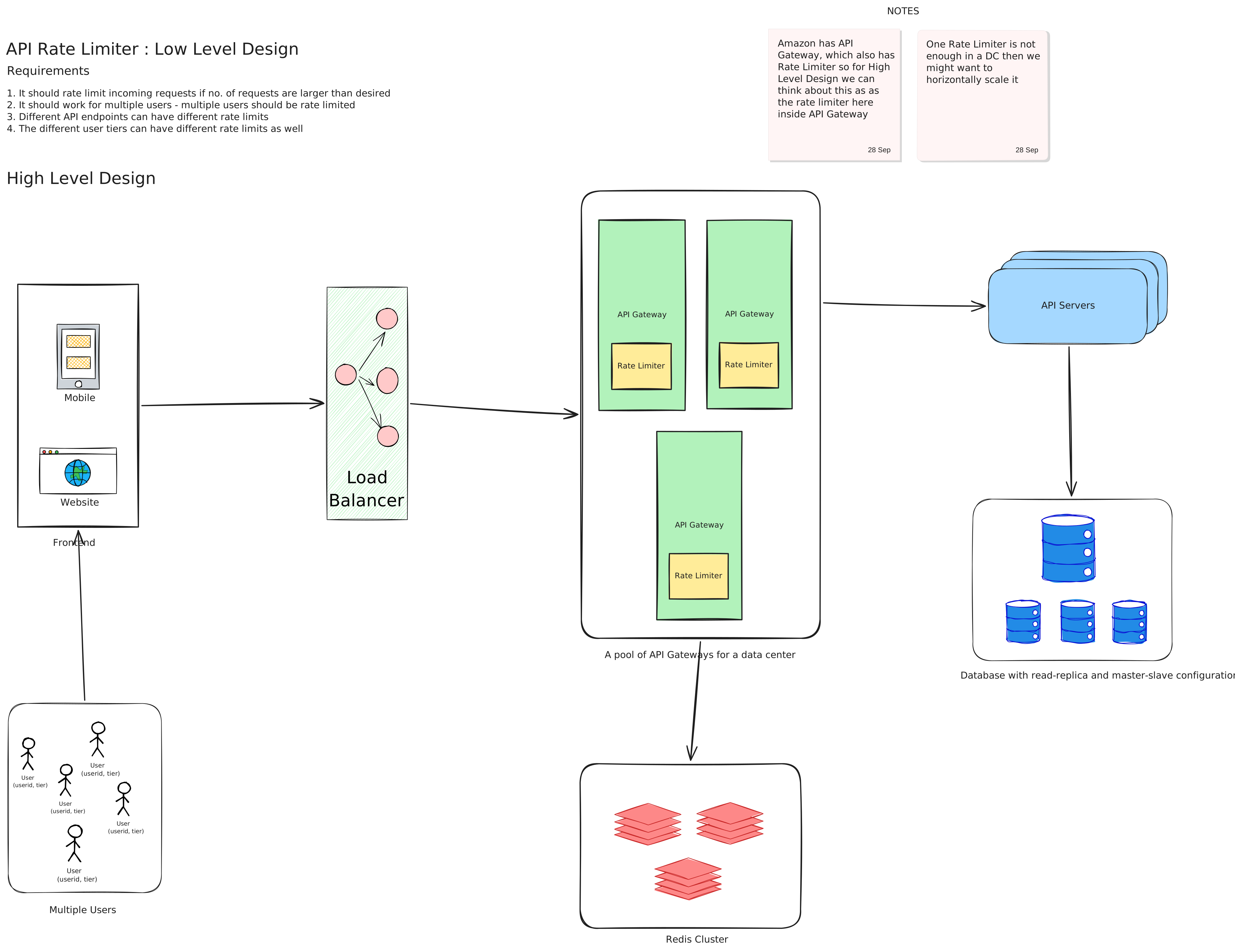
8.1 High-Level Design Architecture
8.2 Core Low-Level Design (Decision Tree & MVP Engine)
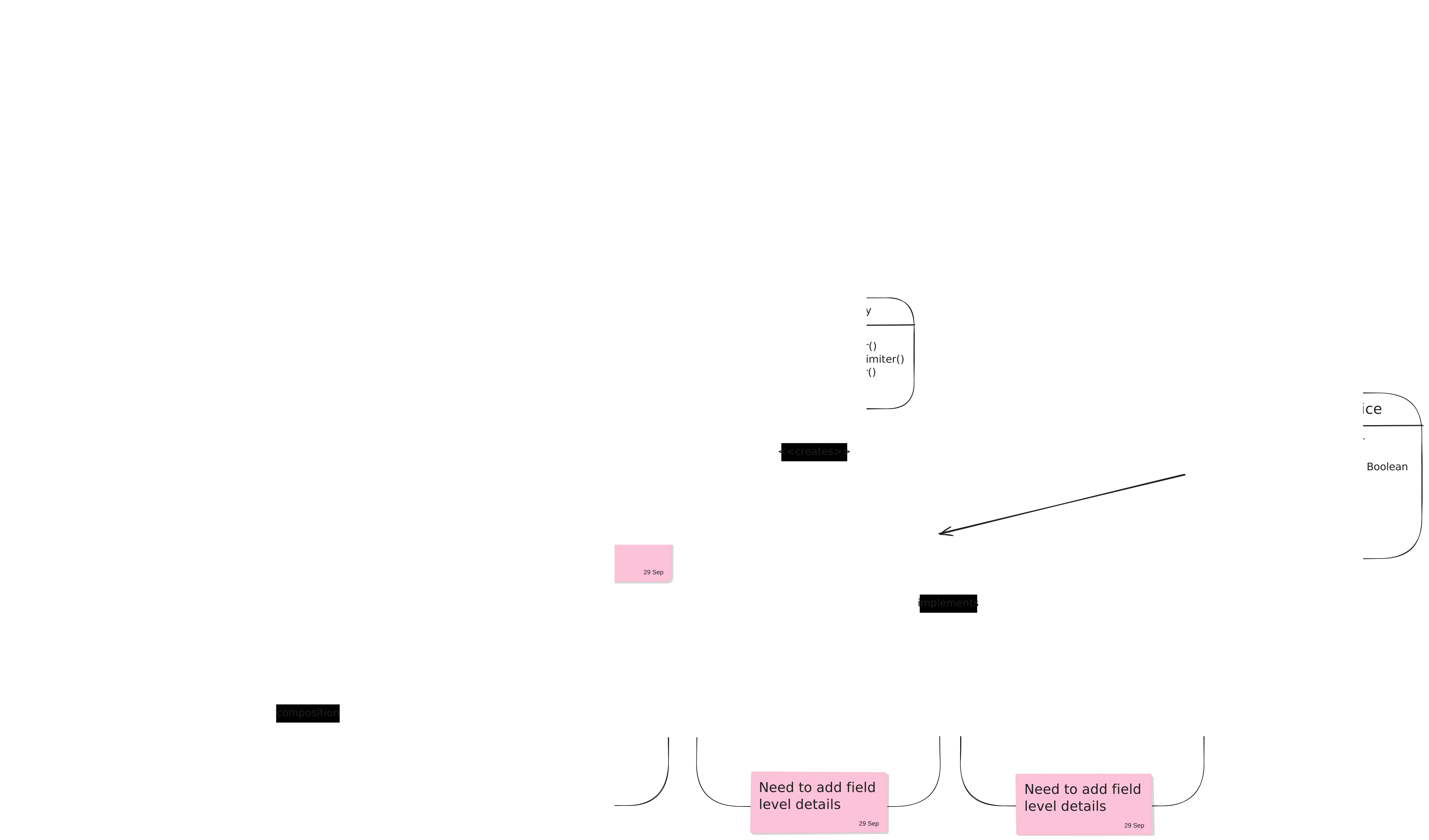
8.3 Full Low-Level Design (User Tiers, Policy Resolution & Rules)