Low-Level Design 2026-10-30
Vending Machine Low-Level Design
A streamlined, production-grade Low-Level Design of an automated Vending Machine in Java 21, featuring State Pattern, inventory slots, and resilient payment workflows.
#State Pattern
View Source on GitHub ↗ Vending Machine System — Low-Level Design (LLD)
1. Problem Statement & Overview
A modern smart vending machine allows customers to select items from physical slots, choose a payment method (UPI, Card, Cash), and receive dispensed products. The system must maintain consistent internal states, gracefully handle payment timeouts and failures, and allow operators to service slots under maintenance mode.
2. High-Level Architecture & Failure Boundaries
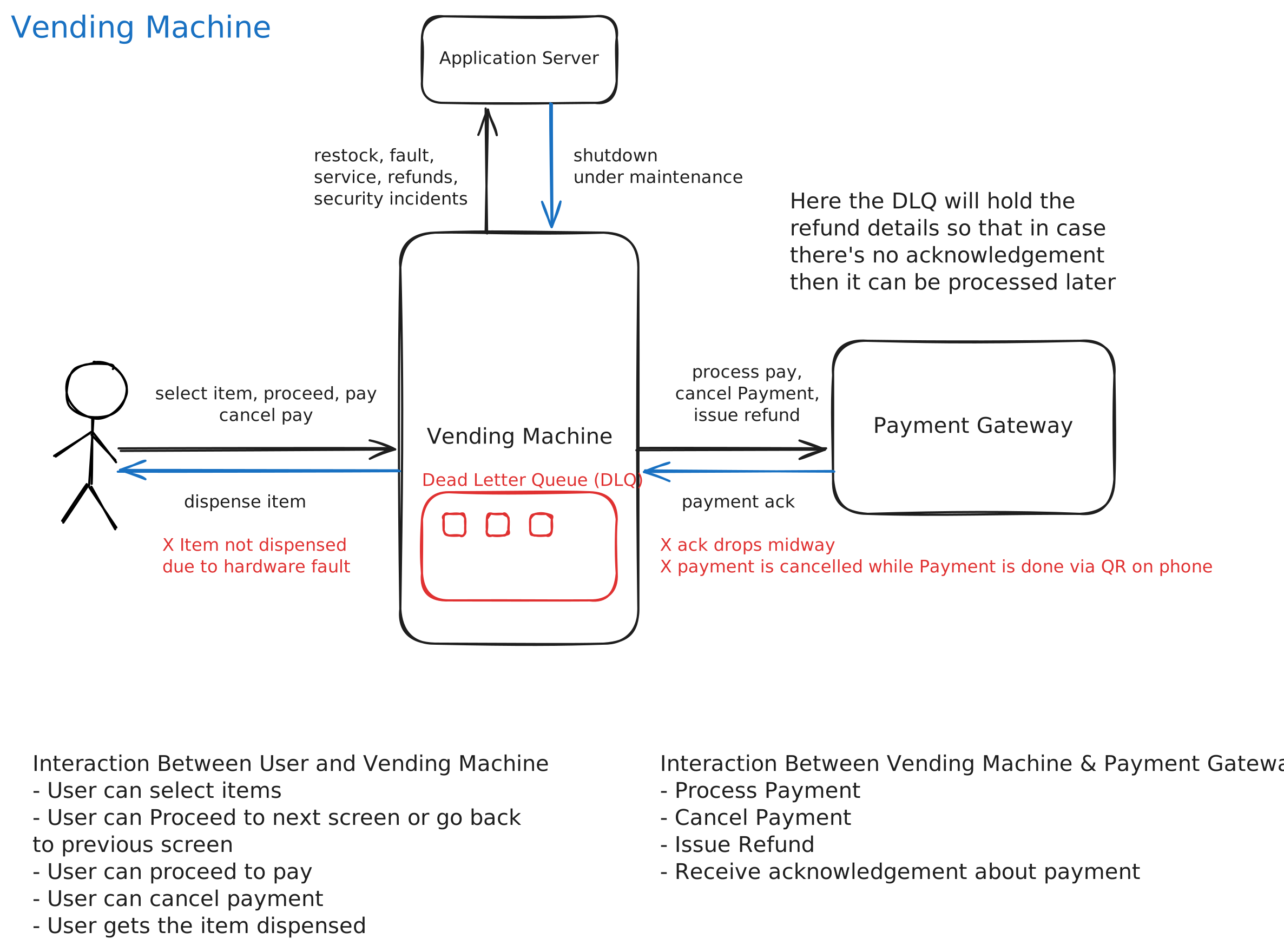
The architecture establishes clear fault boundaries across three critical interfaces:
- Customer Edge & Vending Machine: User drives item selection, payment method choices, screen navigation, or cancellation.
- Vending Machine & Payment Gateway: Manages authorization, capture, refunds, and handles edge conditions such as network dropped acknowledgments or cancellations while QR payments are in-flight on mobile devices.
- Application Server & Dead Letter Queue (DLQ):
- Central application server monitors restock events, hardware health faults, telemetry, and remote maintenance locks.
- The DLQ asynchronously buffers unacknowledged transactions, late payment captures, and failed hardware dispense events to guarantee eventual refund execution without blocking the physical machine.
3. Requirements Analysis
Functional Requirements (FR)
- Catalog & Selection: Customers can view available items and select one or multiple items to initiate a vending session.
- Payment Processing:
- Customer can choose a payment method (UPI, Card).
- System handles asynchronous or synchronous payment outcomes (
PaymentSuccess,PaymentFailure). - If payment fails, customer can switch payment methods or retry without losing their active selection.
- Cancellation & Expiration:
- Customer can cancel the session prior to payment success.
- Sessions expire if inactive beyond a configured timeout.
- Physical Dispensing:
- Upon successful payment verification, the machine triggers physical dispensing.
- On dispensing failure (e.g., hardware jam), the system initiates an automated refund.
- Maintenance:
- Technicians can toggle the machine into
MAINTENANCEmode to restock inventory or perform diagnostics.
- Technicians can toggle the machine into
Non-Functional Requirements (NFR)
- Thread-Safety & Correctness: Slot inventory mutations and session transitions must be thread-safe.
- Deterministic State Transitions: Invalid actions (e.g. attempting to dispense in
IDLEstate) must throw explicit domain exceptions.
4. Finite State Machine (FSM)
The system is governed by a streamlined 5-state lifecycle:
stateDiagram-v2
    [*] --> IDLE

    IDLE --> ITEM_SELECTED : selectItems()
    IDLE --> MAINTENANCE : enterMaintenance()

    ITEM_SELECTED --> PAYMENT : proceedToPay(paymentType)
    ITEM_SELECTED --> IDLE : cancel() / onTimeout()

    PAYMENT --> PAYMENT : choosePaymentType() / handlePaymentFailure()
    PAYMENT --> DISPENSING : handlePaymentSuccess(txnId)
    PAYMENT --> ITEM_SELECTED : cancel() [back to cart]
    PAYMENT --> IDLE : onTimeout() [abandoned session]

    DISPENSING --> IDLE : onDispenseSuccess()
    DISPENSING --> IDLE : onDispenseFailed() [refund triggered]

    MAINTENANCE --> IDLE : exitMaintenance()
State Definitions
| State | Allowed Transitions | Invariant / Responsibility |
|---|---|---|
IDLE | selectItems(), enterMaintenance() | Machine is unoccupied and ready for customers. |
ITEM_SELECTED | proceedToPay(), cancel(), onTimeout() | Items held in active session; awaiting payment commitment. |
PAYMENT | choosePaymentType(), handlePaymentSuccess(), handlePaymentFailure(), cancel(), onTimeout() | Awaiting payment gateway verification. Allows retry on failure. |
DISPENSING | onDispenseSuccess(), onDispenseFailed() | Hardware actuator running; releases inventory or initiates refund. |
MAINTENANCE | exitMaintenance() | Locked out from public customer transactions. |
5. Class Diagram
classDiagram
    class VendingMachine {
        -VendingMachineState state
        -VendingSession session
        -Map~String, Slot~ slots
        +selectItems(List~String~ itemIds)
        +proceedToPay(PaymentType paymentType)
        +choosePaymentType(PaymentType paymentType)
        +handlePaymentSuccess(String txnId)
        +handlePaymentFailure(String reason)
        +cancel()
        +onTimeout()
        +onDispenseSuccess()
        +onDispenseFailed()
        +enterMaintenance()
        +exitMaintenance()
    }

    class VendingMachineState {
        <<interface>>
        +selectItems(VendingMachine, List~String~)
        +proceedToPay(VendingMachine, PaymentType)
        +choosePaymentType(VendingMachine, PaymentType)
        +handlePaymentSuccess(VendingMachine, String)
        +handlePaymentFailure(VendingMachine, String)
        +cancel(VendingMachine)
        +onTimeout(VendingMachine)
        +onDispenseSuccess(VendingMachine)
        +onDispenseFailed(VendingMachine)
        +enterMaintenance(VendingMachine)
        +exitMaintenance(VendingMachine)
        +getStateName() String
    }

    class IdleState
    class ItemSelectedState
    class PaymentState {
        -PaymentType paymentType
        -String lastFailureReason
    }
    class DispensingState {
        -String transactionId
    }
    class MaintenanceState

    VendingMachineState <|.. IdleState
    VendingMachineState <|.. ItemSelectedState
    VendingMachineState <|.. PaymentState
    VendingMachineState <|.. DispensingState
    VendingMachineState <|.. MaintenanceState
    VendingMachine o-- VendingMachineState
    VendingMachine o-- VendingSession
    VendingMachine o-- Slot

    class Slot {
        -String slotCode
        -Item item
        -int quantity
        -int capacity
        -boolean isJammed
        +isAvailable() boolean
        +decrementStock()
        +restock(int qty)
    }

    class Item {
        -String id
        -String name
        -BigDecimal amount
        -ItemCategory category
    }

    class VendingSession {
        -String sessionId
        -List~String~ slotCodes
        -List~Item~ items
        -SessionStatus status
        -Instant expiresAt
        +getTotalAmount() BigDecimal
    }

    Slot o-- Item
    VendingSession o-- Item
6. Sequence Diagram: Payment Failure & Retry Flow
sequenceDiagram
    autonumber
    actor Customer
    participant VM as VendingMachine
    participant State as PaymentState
    participant Dispense as DispensingState

    Customer->>VM: selectItems(["ITEM-1"])
    VM-->>Customer: State: ITEM_SELECTED (Cart Total: $2.50)

    Customer->>VM: proceedToPay(UPI)
    VM-->>Customer: State: PAYMENT (Method: UPI)

    Note over VM,State: Gateway reports transaction failure
    VM->>State: handlePaymentFailure("UPI_TIMEOUT")
    State-->>VM: Remains in PAYMENT (Stores lastFailureReason)
    VM-->>Customer: "UPI failed. Please retry or choose another method."

    Customer->>VM: choosePaymentType(CARD)
    VM->>State: choosePaymentType(CARD)

    Note over VM,State: Customer swipes card, Gateway confirms
    VM->>State: handlePaymentSuccess("TXN-CARD-99")
    State->>VM: setState(new DispensingState("TXN-CARD-99"))
    VM-->>Customer: State: DISPENSING

    VM->>Dispense: onDispenseSuccess()
    Dispense->>VM: clearSession() & setState(new IdleState())
    VM-->>Customer: State: IDLE (Product dispensed)
7. Empirical Verification & Test Suite
The test suite in VendingMachineTest.java covers:
- Happy Path: Full cycle through item selection, payment confirmation, and product dispensing.
- Payment Failure & Method Switching: Retrying a failed UPI attempt with a credit card without losing active session state.
- Cancellation: Graceful abort in both
ITEM_SELECTEDandPAYMENTstates. - Maintenance Locks: Verification that customer requests are rejected during maintenance mode.
- Illegal Transition Guards: Assertion that operations out-of-order throw
IllegalStateException.